FAQs about Ramanujan

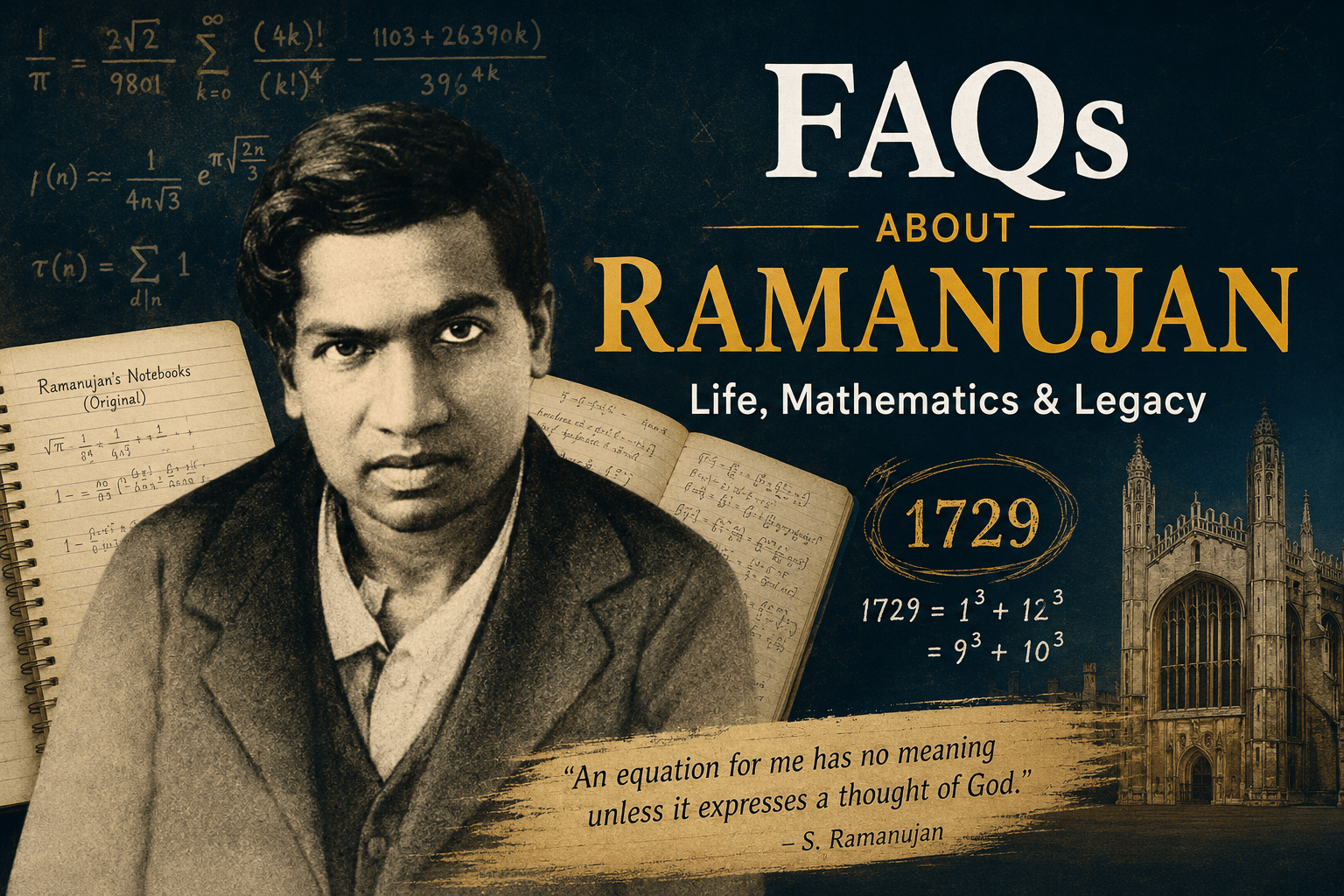
Srinivasa Ramanujan is widely regarded as one of the most remarkable mathematical minds in history. Despite having little formal training in advanced mathematics, he produced groundbreaking ideas that continue to influence modern research. His work covered number theory, infinite series, continued fractions, and mathematical analysis, often revealing results that astonished leading mathematicians of his time. Ramanujan's story is also one of perseverance, creativity, and intellectual curiosity. More than a century after many of his discoveries were made, mathematicians around the world continue to study, verify, and expand upon his insights, ensuring that his legacy remains highly relevant today.
Who was Srinivasa Ramanujan?
Srinivasa Ramanujan was an Indian mathematician born in 1887 in Tamil Nadu. He became famous for developing original mathematical formulas and theories with minimal formal education. His work gained international recognition after collaborating with British mathematician G. H. Hardy at Cambridge University.
Why is Ramanujan famous?
Ramanujan is famous for discovering highly original mathematical formulas and identities. Many of his findings were decades ahead of their time and later proved correct. His contributions to number theory, infinite series, and partitions continue to influence modern mathematics.
What was Ramanujan's full name?
His full name was Srinivasa Ramanujan Aiyangar. However, he is commonly known simply as Srinivasa Ramanujan or Ramanujan. His name has become synonymous with extraordinary mathematical talent and intuition.
Did Ramanujan have formal mathematical training?
Ramanujan received basic education but lacked extensive formal training in advanced mathematics. Much of his knowledge came from studying mathematical books independently. His self-taught approach allowed him to develop unique methods and unconventional perspectives.
How did Ramanujan meet G. H. Hardy?
Ramanujan sent a letter containing mathematical results to G. H. Hardy in 1913. Hardy recognized the extraordinary originality of the work and invited him to Cambridge. Their collaboration became one of the most famous partnerships in mathematical history.
What mathematical fields did Ramanujan work on?
Ramanujan made contributions to number theory, infinite series, continued fractions, modular forms, partitions, and mathematical analysis. His notebooks contained thousands of results spanning multiple areas of mathematics, many of which continue to be studied today.
What is the Ramanujan number?
The Ramanujan number is 1729, famous for being the smallest number expressible as the sum of two cubes in two different ways. The story became legendary after Hardy mentioned the number during a hospital visit to Ramanujan.
Why is 1729 important?
The number 1729 equals 1³ + 12³ and also 9³ + 10³. Ramanujan immediately recognized this special property when Hardy described it as an uninteresting number, turning it into one of mathematics' most famous anecdotes.
What are Ramanujan's notebooks?
Ramanujan's notebooks are collections of mathematical formulas, theorems, and observations he recorded throughout his life. They contain thousands of results, many without proofs, inspiring generations of mathematicians to investigate and verify them.
What is the Lost Notebook of Ramanujan?
The Lost Notebook is a collection of Ramanujan's unpublished work discovered decades after his death. It contains important formulas and insights that have led to significant advances in modern mathematical research.
Did Ramanujan prove all of his results?
No. Ramanujan often wrote down final results without detailed proofs. While this created challenges for later mathematicians, many of his formulas were eventually proven correct and found to be mathematically significant.
What awards did Ramanujan receive?
Ramanujan was elected a Fellow of the Royal Society in 1918. He also became a Fellow of Trinity College Cambridge, achievements that reflected his exceptional contributions to mathematics.
How old was Ramanujan when he died?
Ramanujan died in 1920 at the age of 32. Although his life was short, the volume and significance of his mathematical work have secured his place among history's greatest mathematicians.
What caused Ramanujan's death?
The exact cause remains debated by historians and medical researchers. Various illnesses have been suggested, including complications related to infection and nutritional deficiencies experienced during his years abroad.
Was Ramanujan considered a genius?
Yes. Mathematicians widely regard Ramanujan as a genius because of his extraordinary ability to discover deep mathematical relationships intuitively. His achievements are especially remarkable given his limited access to formal education and research resources.
What is Ramanujan's contribution to number theory?
Ramanujan developed important formulas and identities involving prime numbers, partitions, and arithmetic functions. His work laid foundations for later discoveries and continues to influence contemporary research in number theory.
Are Ramanujan's discoveries still used today?
Yes. Modern mathematicians regularly use ideas connected to Ramanujan's work. His formulas have applications in pure mathematics, theoretical physics, computer science, cryptography, and other advanced scientific fields.
What movies have been made about Ramanujan?
One of the most well-known films about his life is The Man Who Knew Infinity. The movie explores his journey from India to Cambridge and his collaboration with Hardy.
Why is Ramanujan celebrated in India?
Ramanujan is celebrated as one of India's greatest intellectual figures. His achievements demonstrate how talent, determination, and curiosity can overcome limited opportunities and inspire future generations of students and researchers.
When is National Mathematics Day in India?
India celebrates National Mathematics Day on December 22, Ramanujan's birthday. The occasion honors his contributions and promotes interest in mathematics among students, educators, and the wider public.
What is Ramanujan's legacy today?
Ramanujan's legacy extends beyond mathematics. He symbolizes creativity, perseverance, and intellectual excellence. His discoveries continue to generate new research, while his life story inspires people worldwide to pursue knowledge and innovation.
Srinivasa Ramanujan remains one of the most influential mathematicians in history. His intuitive brilliance, groundbreaking discoveries, and remarkable life journey continue to captivate scholars and enthusiasts alike. From the famous number 1729 to the enduring impact of his notebooks, Ramanujan's work has shaped modern mathematics in profound ways. More than a century later, researchers still uncover new insights from his ideas, ensuring that his contributions remain relevant for generations to come.
 Team qwikFAQs
 Team qwikFAQs