What If Democracy Was Run by Algorithms?

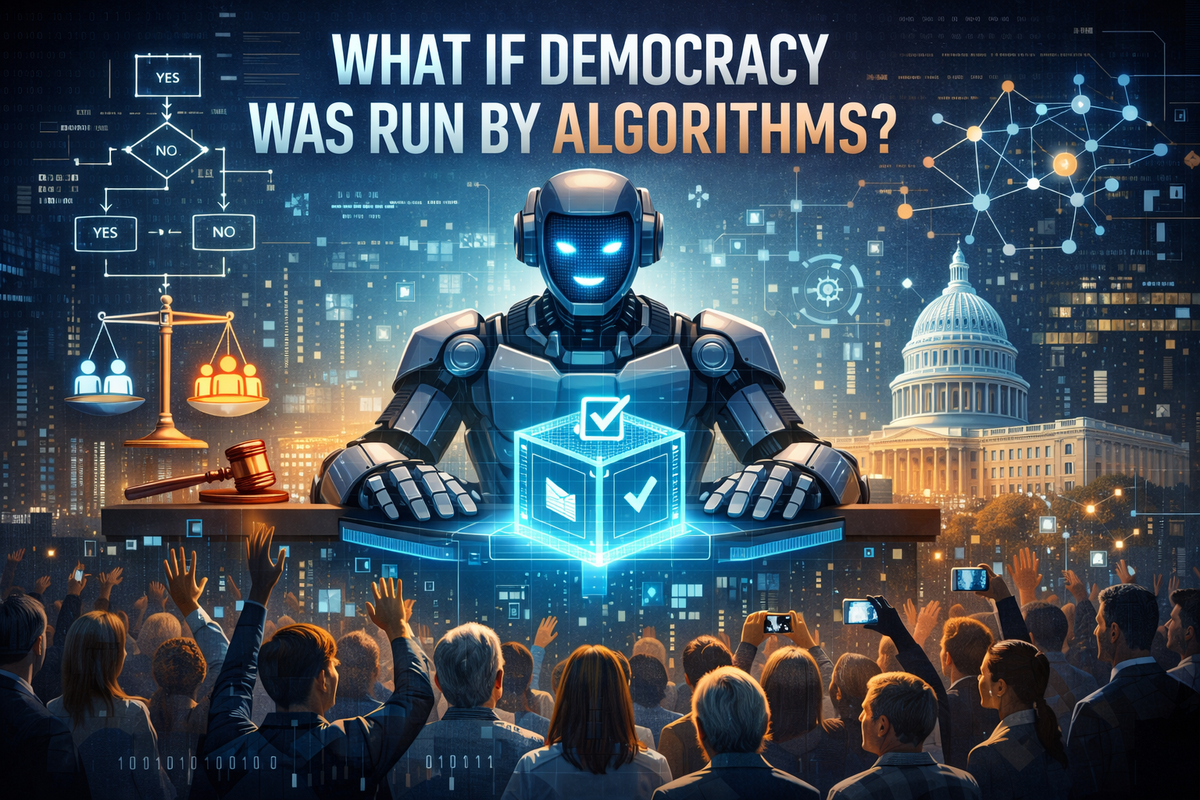
An exploration of code, citizens, and the future of governance
Introduction | When the Ballot Box Meets the Black Box
Imagine waking up on election day and instead of lining up at a polling booth, you receive a notification: "Your vote has been calculated." No speeches, no debates, no campaign posters taped to every available wall. Just an algorithm quietly processing terabytes of data to determine what policies should be enacted, which leaders are best suited to govern, and how national priorities should shift.
At first glance, algorithmic democracy sounds like either a Silicon Valley fever dream or the plot of a dystopian sci-fi series. But beneath the humor lies a serious question that political scientists, technologists, and citizens around the world are beginning to ask: what if democracy was partially—or entirely—run by algorithms?
As artificial intelligence increasingly shapes finance, healthcare, logistics, and even art, governance feels like the next frontier. This article takes a global, forward-looking look at how algorithm-driven democracy could work, where it might fail, and why the idea refuses to stay hypothetical.
What Is Algorithmic Governance?
Algorithmic governance refers to the use of automated systems, data models, and artificial intelligence to assist or make decisions traditionally handled by human institutions. In a democratic context, this could include:
- Drafting and evaluating public policy
- Allocating government budgets
- Drawing electoral boundaries
- Prioritizing legislation
- Even selecting or ranking political representatives
Unlike traditional bureaucracy, algorithms promise consistency, scalability, and speed. They do not get tired during parliamentary sessions or change opinions based on applause. But they also inherit the assumptions, data, and biases embedded in their design.

Why the Idea Is Gaining Traction
Algorithmic democracy is not emerging in a vacuum. Several global trends are pushing the concept from theory toward experimentation.
1. Declining Trust in Political Institutions
According to surveys by organizations such as Pew Research Center, trust in governments and elected officials has declined in many democracies worldwide. Voters often perceive politicians as inefficient, corrupt, or disconnected from real-world problems. Algorithms, by contrast, are marketed as neutral problem-solvers.
2. Data Is Already Running the World
Governments already rely heavily on algorithms for tax fraud detection, welfare distribution, traffic management, and risk assessment. Expanding their role into policymaking is a logical, if controversial, next step.
3. The Scale Problem of Modern Democracies
Managing millions—or billions—of citizens with diverse needs is extraordinarily complex. AI systems excel at handling scale and complexity, potentially enabling more responsive and granular governance.
How Algorithmic Democracy Could Actually Work
Contrary to popular imagination, algorithmic democracy does not necessarily mean replacing elections overnight. More plausible models involve hybrid systems.
Data-Informed Policy Engines
Algorithms could analyze economic indicators, public sentiment, environmental data, and historical outcomes to recommend policy options. Legislators would retain final authority but with far richer evidence.
Dynamic Public Opinion Modeling
Instead of elections every few years, governments could continuously measure public preferences using anonymized data, surveys, and digital participation tools. Policies could adapt in near real time.
AI-Moderated Deliberation
Online democratic forums often collapse into noise. AI systems could moderate discussions, summarize arguments, surface consensus points, and reduce misinformation—improving civic discourse rather than replacing it.
The Potential Benefits | Why Some People Are Excited
Efficiency Without Coffee Breaks
Algorithms do not procrastinate, form committees that lead to more committees, or delay decisions because of election cycles. Policy simulations that once took months could run in minutes.
Evidence Over Rhetoric
Campaign slogans might finally lose to statistical models. Policies could be evaluated on predicted outcomes rather than political popularity.
Reduced Human Bias—In Theory
Properly designed systems could help counteract certain cognitive biases such as favoritism, short-termism, or emotional decision-making. This is particularly appealing in areas like judicial sentencing or welfare allocation.
The Risks | When Code Becomes Power
Of course, handing the keys of democracy to algorithms raises concerns that cannot be brushed aside with clever code comments.
Bias Doesn’t Disappear—It Scales
Algorithms learn from data, and data reflects history. If past decisions were biased, automated systems can amplify those biases at unprecedented scale. This issue has already been documented in predictive policing and credit scoring systems.
Transparency vs. Complexity
Modern machine-learning models, especially deep neural networks, can be difficult even for experts to interpret. A democracy that cannot explain its decisions risks becoming a black-box state.
Who Writes the Code?
Perhaps the most important question is not what the algorithm decides, but who designs it, maintains it, and audits it. Power does not vanish—it shifts.
Accountability in an Algorithmic Democracy
In traditional democracies, accountability is clear in principle: elected officials can be voted out. But how do citizens hold an algorithm accountable?
Possible mechanisms include:
- Mandatory algorithmic transparency laws
- Independent public audits of government AI systems
- Open-source governance code
- Legal frameworks assigning responsibility to deploying institutions
The European Union’s evolving AI regulatory framework offers early insight into how such accountability might be structured at scale.
External reference: https://digital-strategy.ec.europa.eu/en/policies/regulatory-framework-ai
Would Citizens Accept It?
Public acceptance is not guaranteed. While people trust algorithms for navigation and shopping recommendations, governance touches identity, values, and fairness.
Interestingly, studies suggest citizens are more open to algorithmic assistance in technical domains (like traffic or tax optimization) than in moral or symbolic decisions. Full algorithmic democracy may therefore arrive in layers, not leaps.
A Future of Co-Governance, Not Replacement
The most realistic future is not one where algorithms replace democracy, but where they reshape it. Think of AI as an always-on policy advisor—fast, analytical, and tireless—paired with human judgment, ethics, and accountability.
Much like calculators did not end mathematics, algorithms are unlikely to end politics. They may, however, force societies to confront long-standing inefficiencies and biases with uncomfortable clarity.
Conclusion | Democracy, Now With Version Updates
If democracy were run by algorithms, it would not automatically become fairer, smarter, or more just. But it would become different—faster in some ways, riskier in others, and deeply dependent on how thoughtfully humans design and govern the systems behind the scenes.
The real question is not whether algorithms will influence democracy—they already do. The question is whether societies will shape that influence deliberately, transparently, and inclusively, or allow it to evolve unnoticed until the notification arrives: "Your vote has been calculated."